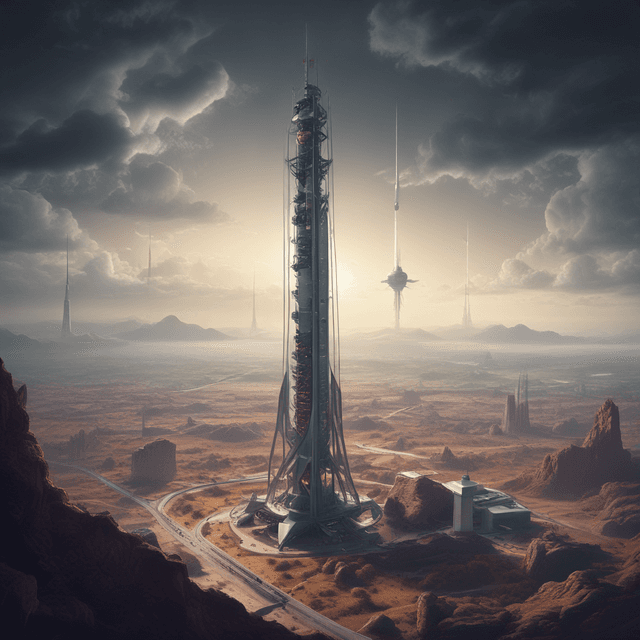
| Name | Earthly Build Framework |
| Type | International consortium |
| Goals | Reduce costs of space travel and exploration |
| Purpose | Develop and construct a massive space elevator |
| Challenges | Technical • Political • Economic |
| Key members | Scientists • Engineers • Government agencies |
The Earthly Build Framework Space Elevator Project is an ongoing international effort to construct a permanent transportation link between the Earth's surface and outer space. The project is spearheaded by a consortium of national space agencies, engineering firms, and materials science research institutes from over two dozen countries around the world.
The concept of a "space elevator" capable of lifting payloads and people into orbit without the use of rockets has been discussed by scientists and science fiction authors since the late 19th century. However, it was not until the 1970s that serious engineering proposals were developed, based on advancements in materials that could theoretically support the immense weight and stresses of such a structure.
In the early 2000s, a group of international experts convened to further study the feasibility of a space elevator. They determined that with sufficient funding and international cooperation, the project could become reality within the lifetimes of those involved. This led to the formation of the Earthly Build Framework in 2008, a consortium pooling resources and expertise from dozens of nations.
The primary technical challenge of the space elevator project has been finding a material strong and light enough to form the "tether" or "cable" connecting an anchor point on the Earth's surface to a counterweight in geostationary orbit. Recent breakthroughs in carbon nanotube and graphene production have produced fibers hundreds of times stronger than steel at a fraction of the weight.
Robotic construction techniques have also been critical, as the enormous scale of the elevator structure - potentially over 60,000 km tall - makes it impossible for human crews to assemble. Autonomous drones, 3D printing of components, and laser welding are just some of the technologies being leveraged.
Furthermore, advances in renewable energy, electromagnetic propulsion, and smart materials have enabled the design of a self-powered, self-repairing elevator system that can safely transport cargo and passengers up and down the tether.
As of 2022, the Earthly Build Framework is in the advanced planning and prototyping stages of the space elevator project. Significant progress has been made on the core tether technology, with demonstration models over 1,000 km long having undergone successful testing.
However, a number of major technical hurdles remain, including:
Politically, the project has also faced challenges in maintaining funding and cooperation between its diverse international stakeholders. Concerns have been raised about the potential militarization of the technology, as well as its environmental impact.
If ultimately successful, the space elevator would dramatically transform global access to space. The immense reduction in the cost and difficulty of space travel could enable exponential growth in fields like satellite communications, space tourism, asteroid mining, and off-world colonization.
Proponents argue the project would also have major geopolitical implications, fostering greater international cooperation and reducing the dominance of any single nation in space activities. Critics, however, warn it could become a new locus of global competition and conflict.
The environmental impacts of the space elevator are also highly debated, with concerns ranging from the structural footprint on the Earth's surface to the potential for catastrophic failure and debris cascades. Advocates insist the elevator will have a far smaller carbon footprint than conventional rocket-based space access.
Ultimately, the Earthly Build Framework's success or failure in constructing this engineering megaproject may be one of the defining technological stories of the 21st century, with implications reaching beyond just the realm of space exploration.
